

Social Media and the Teenage Brain: What Every Student Should Know
Have you ever opened Instagram or YouTube for "just five minutes" and then realized that half an hour has disappeared? If your answer is yes, you are certainly not alone.
Today's students are growing up in a world where social media is woven into everyday life. It helps us stay connected, learn new things, and even express ourselves creatively. However, there is another side to this story-one that affects our attention, sleep, emotions, confidence, and even the way we think about ourselves.
Many students complain that they cannot focus on studies, feel distracted all the time, struggle with motivation, or compare themselves constantly with others. Many of them believe they simply lack discipline. In reality, the issue is often much deeper. The way social media is designed can influence how the brain functions, especially during the teenage years when the brain is still developing.
Why Is Social Media So Hard to Put Down?
Many students ask me, "Why do I keep scrolling even when I know I should stop?"
The answer lies in the brain's reward system.
Every time we receive a like, watch an entertaining reel, or discover something new online, the brain releases a chemical called dopamine. Dopamine is not the "happiness chemical," as it is often described. Instead, it is the brain's way of saying, "Pay attention to this. This might be rewarding."
The problem is that social media provides these rewards very quickly and very frequently. One funny reel follows another. One notification leads to another. The brain begins to expect constant stimulation.
Over time, activities that offer slower rewards-such as studying, reading, solving mathematics problems, or practicing a skill-can start to feel less interesting by comparison. Students can often watch reels for an hour, but can't sit with a textbook for ten minutes. This is not because they are lazy. It is because their brains have become accustomed to a much faster pace of stimulation.
The Impact on Attention and Focus
Attention is like a muscle. The more we train it, the stronger it becomes.
Unfortunately, short-form content often trains the brain in the opposite direction. Most reels, shorts, and quick videos last only a few seconds. The brain becomes used to receiving new information almost instantly.
As a result, many students find it difficult to concentrate on tasks that require sustained focus. Reading a chapter, writing an essay, or solving a lengthy problem can begin to feel unusually difficult.
Another common issue is frequent task-switching. A student may be studying, then checking a notification, replying to a message, watching a short video, and returning to studies. Although this feels like multitasking, the brain is actually switching rapidly between tasks.
Each interruption comes with a cost. The brain needs time to regain focus. When this cycle repeats throughout a study session, learning becomes less efficient and mental fatigue increases.
Sleep: The Hidden Casualty
One of the most underestimated effects of excessive social media use is poor sleep.
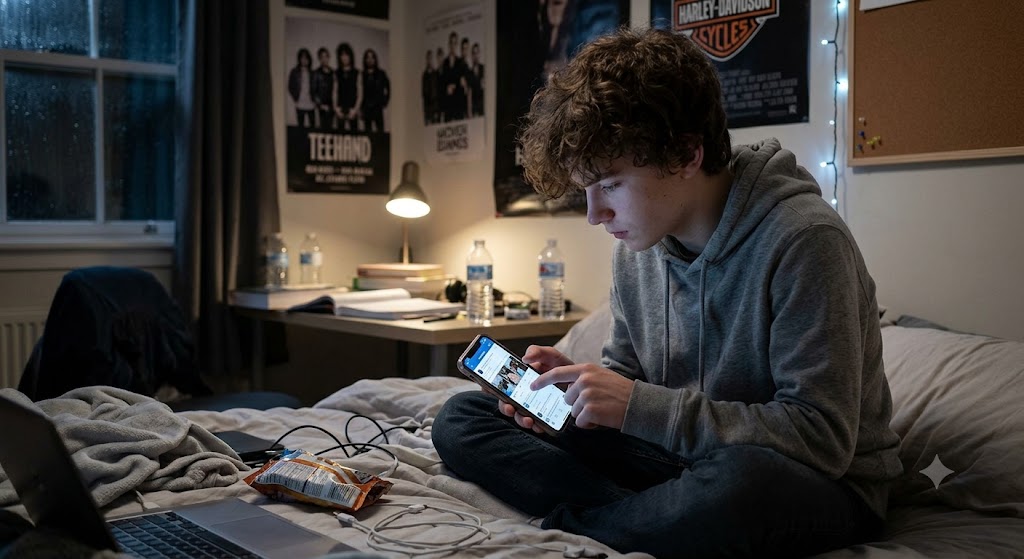
Many students scroll through their phones late at night, believing it helps them relax. Ironically, the opposite often happens.
The blue light emitted by screens signals to the brain that it is still daytime. This delays the release of melatonin, a hormone that helps regulate sleep. At the same time, engaging content keeps the brain mentally active when it should be winding down.
Poor sleep affects concentration, memory, mood, and academic performance. In fact, one of the most effective ways to improve learning is not studying longer-it is sleeping better.
When students sacrifice sleep for scrolling, they often pay the price the next day through reduced focus and increased mental exhaustion.
The Fear of Missing Out
Social media has also created a phenomenon known as FOMO-the Fear of Missing Out.
Many teenagers feel pressure to stay constantly connected. There is anxiety about missing a message, a trend, a meme, or an event that friends are discussing.
This can create a cycle where students repeatedly check their phones, even when there is no real need to do so. The result is a mind that remains in a state of constant anticipation.
The Comparison Trap
Perhaps one of the most significant psychological effects of social media is constant comparison.
When scrolling through social media, we are usually seeing the most polished, exciting, and carefully selected moments of other people's lives. We see achievements, vacations, celebrations, and success stories.
What we do not see are the struggles, failures, disappointments, and ordinary moments that exist behind the scenes.
The human brain naturally compares. When students repeatedly compare their everyday lives to someone else's highlight reel, feelings of inadequacy can emerge.
As a result, many teenagers begin to question their own worth based on unrealistic standards.
What Can Students Do?
The good news is that social media is not the enemy. The goal is not to eliminate it completely. Instead, the goal is to use it consciously.
A few simple habits can make a significant difference:
- Keep the phone physically away during study sessions.
- Turn off non-essential notifications.
- Avoid social media during the first 30 minutes after waking up.
- Avoid scrolling for at least 30–60 minutes before bedtime.
- Use grayscale mode to make apps less visually stimulating.
- Take regular breaks from screens.
- Spend time on activities that build focus, such as reading, sports, music, or creative hobbies.
Most importantly, remember that your attention is one of your most valuable resources. Every app, platform, and notification is competing for it.
The question is not whether social media is good or bad. The real question is whether you are using social media intentionally-or whether it is using your attention without you realizing it.
As students, your future will be shaped not only by your intelligence but also by your ability to focus. In a world full of distractions, attention has become a superpower!
Unlock Your Full Potential with BrainHap
Don't let uncertainty hold you back. Discover your strengths and build a future-proof career with our AI-driven assessments.
Start Your Free Assessment