


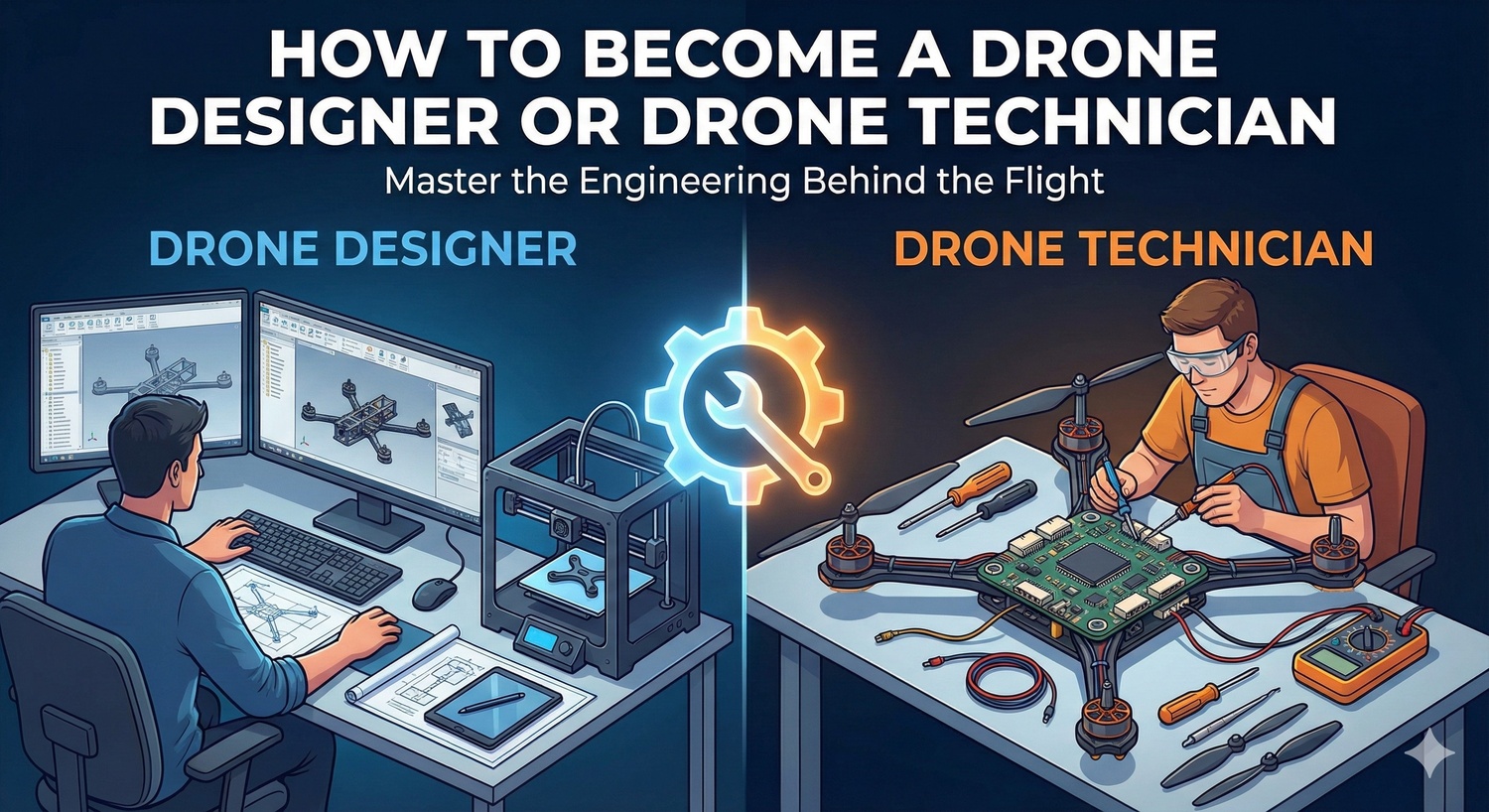
How to Become a Drone Designer or Drone Technician
Intro
Most parents and students see a drone flying and think, "I want to be the Pilot."
But the surprising truth?
For every 1 pilot in the sky, the industry needs 3 experts on the ground to build, calibrate, and fix those machines.
Pilots fly them. But Designers create them, and Technicians keep them alive.
In 2025, the highest-paid opportunities aren't just in flying the drone—but in understanding the engineering inside it.
Not just assembling a toy kit… But learning the art of aerodynamics, electronics, and troubleshooting.
Let’s walk through how you can become the "Engineer behind the Ace."
🛠️ Step 1: The Technician — Be the "Doctor" of Drones
Drones crash. Propellers break. Motors burn out.
A Drone Technician is like a doctor. They don't just guess; they diagnose.
Your Toolkit:
-
Soldering Iron: The stethoscope of a technician. You must master the art of connecting wires.
-
Multimeter: To check if power is flowing correctly.
-
Hex Drivers: To disassemble the frame instantly.
The Skill:
-
Identifying why a drone is vibrating.
-
Replacing a burnt ESC (Electronic Speed Controller).
-
Fixing a broken video feed.
If you love fixing broken things, this is your entry point.
🎨 Step 2: The Designer — Be the "Architect" of the Sky
A Technician fixes what exists. A Designer creates what doesn't exist yet.
-
"We need a drone that can carry 10kg of fertilizer."
-
"We need a drone that can fit inside a small pipe."
Your Toolkit:
-
CAD Software (Fusion 360 / SolidWorks): To draw the frame in 3D.
-
3D Printer: To print your prototype parts.
-
Physics Knowledge: Understanding Thrust-to-Weight ratio.
The Skill: Balancing weight, strength, and battery life to create the perfect flying machine.
🔌 Step 3: Master the Anatomy — It’s All About Components
Whether you design or fix, you must know the organs of the drone.
The "Big 4" Components:
-
Frame: The skeleton (Carbon Fiber).
-
Motors & Props: The muscles (Propulsion).
-
Flight Controller (FC): The brain (Sensors & Gyros).
-
ESC: The nervous system (Power distribution).
Activity:
-
Don't buy a Ready-to-Fly (RTF) drone.
-
Buy a DIY Kit and assemble it yourself.
-
If you build it, you know how to fix it.
💻 Step 4: The Software — Tuning the Brain
A drone is just a brick until you program it.
You don't need to write complex code from scratch, but you must know how to configure the firmware.
Tools to learn:
-
Betaflight / INAV: The standard software to tune racing and freestyle drones.
-
Mission Planner: For autonomous GPS waypoints (Agricultural/Survey drones).
The Magic: Changing a "PID value" in the software can turn a wobbly drone into a laser-precise machine.
🌍 Step 5: Solve Real Problems — Custom Builds
This is where you turn pro. Move beyond hobby kits.
Real-world challenges:
-
Agriculture: Build a waterproof drone that sprays pesticides.
-
Cinema: Build a "Cinewhoop" (safe, ducted drone) for indoor shooting.
-
Racing: Build a lightweight drone that hits 150km/h.
The Career: Companies pay huge amounts for custom solutions that you cannot buy in a store.
📣 Step 6: Build Your Portfolio — Show Your Scars
A degree is good. A video of a drone you built from scratch is better.
Document your work:
-
"Here is how I designed a 3D-printed landing gear."
-
"Watch me fix this water-damaged flight controller."
-
"I tuned this drone to fly stable in high winds."
In the hardware world, your "bench time" (time spent building/fixing) is your resume.
🚀 Step 7: Grow Into an Innovator — Naturally, Not Forcefully
You don't become a Chief Drone Engineer in a day. You grow into it.
Solder joint by solder joint. Crash by crash.
You become the person who can: ✔ look at a crash and know exactly what failed ✔ solder tiny wires with surgical precision ✔ design a frame that is light yet unbreakable ✔ integrate new sensors (LiDAR, Thermal Cameras) ✔ build machines that defy gravity
That’s all a modern Drone Expert needs.
🔮 The Future: Customization is King
The future isn't just about buying DJI drones. It's about modifying and building specialized bots.
The future belongs to students who can:
-
design unique frames
-
repair expensive industrial drones
-
integrate AI with drone hardware
You don’t need a factory. You just need a workbench and a curious mind.
❤️ Final Words
You don’t need an aeronautical engineering degree to start. You don’t need a million-dollar lab.
You just need: ✔ a soldering iron ✔ a basic DIY drone kit ✔ patience (you will burn a few parts!) ✔ steady hands ✔ courage to take things apart
The drone industry needs Pilots, yes. But it is desperate for Builders.
💬 “Pilots claim the glory, but Technicians keep them in the sky.”
Your journey to becoming a Drone Engineer begins today — with a single screw.
🚀 Brainhap Edge
At Brainhap, we believe in "Making" over just "Using."
That’s why our Drone programs are hands-on engineering labs, not just flight schools.
We help learners: ✔ Master the art of soldering and wiring ✔ Understand the physics of flight ✔ Assemble their own drones from scratch ✔ Learn 3D design for custom parts ✔ Configure Flight Controllers using software ✔ Troubleshoot and repair crashes ✔ Build custom drones for specific missions ✔ Build confidence as a "Hardware Engineer"
Whether you want to design the next big drone or run a repair business — Brainhap gives you the tools, mindset, and confidence to build the future.
Your journey starts with curiosity. We guide you through the rest.
Unlock Your Full Potential with BrainHap
Don't let uncertainty hold you back. Discover your strengths and build a future-proof career with our AI-driven assessments.
Start Your Free Assessment