


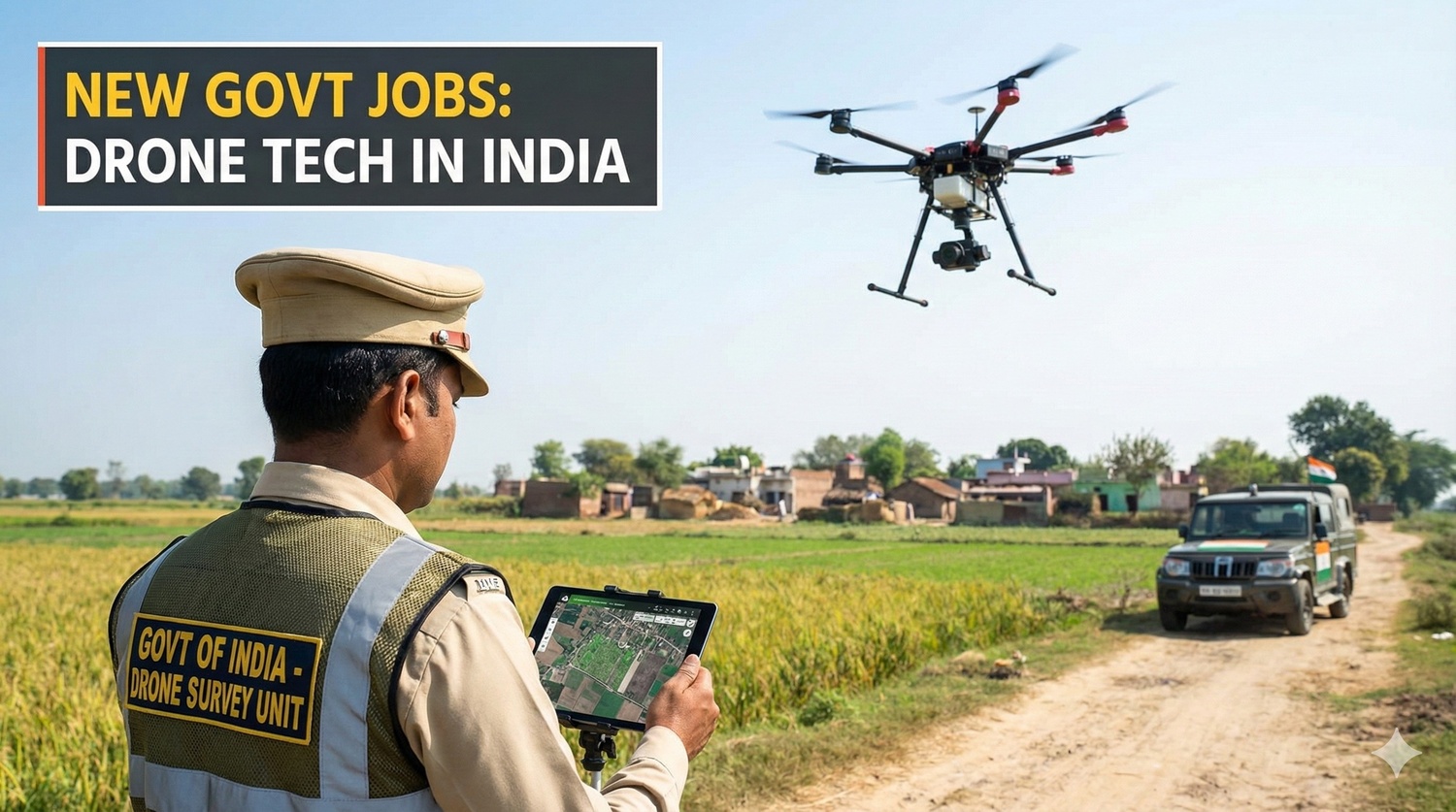
How Drone Technology Is Creating New Government Jobs
Intro When people think of "Government Jobs" in India, they usually picture dusty files, slow computers, and endless desk work. 🏛️😴 But the stereotype is outdated. The modern Indian government is rapidly digitizing, and one technology is leading the charge from the skies: Drones. Under initiatives like "Drone Shakti," the government isn't just encouraging private companies; it is actively integrating drones into public administration. This isn't science fiction. It's happening right now. From mapping every inch of Indian land to monitoring vast railway networks, drones are becoming essential infrastructure tools. And guess what? Drones don't fly themselves. They don't analyze their own data. This shift is creating an entirely new category of government careers—tech-savvy, field-based, and crucial for national development. Let’s look at the new public sector roles taking flight. 🚁✈️
🗺️ Step 1: Land Surveying & Mapping — The SVAMITVA Revolution India has a massive, centuries-old problem: unclear land ownership records in rural areas. The Drone Mission: The SVAMITVA scheme aims to map residential land in lakhs of villages using high-resolution drone cameras. The New Govt Job: GIS Drone Cartographer.
-
It’s not just about flying. The government needs specialists who can take terabytes of drone imagery and convert them into legally valid, centimeter-accurate digital maps using GIS (Geographic Information System) software.
-
The Impact: Providing property cards to millions of rural Indians. 🏠
🌾 Step 2: Agriculture & Rural Development — The "Kisan Drone" Manual spraying of pesticides is hazardous to farmer health and inefficient. The Drone Mission: The government is heavily subsidizing "Kisan Drones" for crop assessment, digitization of land records, and spraying of insecticides and nutrients. The New Govt Job: Krishi Drone Technical Officer.
-
State agriculture departments and Krishi Vigyan Kendras (KVKs) need skilled technicians who can operate heavy-lift agricultural drones and train local farmers.
-
The Impact: Modernizing Indian agriculture and protecting farmer health. 🚜
🏗️ Step 3: PSUs & Infrastructure — Monitoring the Giants Inspecting thousands of kilometers of power lines, gas pipelines, or railway tracks manually is slow, dangerous, and expensive. The Drone Mission: Public Sector Undertakings (PSUs) like Indian Railways, PowerGrid, NHAI, and GAIL are mandating drone usage for asset monitoring and project tracking. The New Govt Job: Industrial Drone Inspector (PSU Cadre).
-
These roles involve using drones equipped with thermal cameras and LiDAR to detect faults in high-voltage towers or cracks in railway bridges without shutting down operations.
-
The Impact: Ensuring the safety and reliability of India's critical infrastructure. ⚡
🚨 Step 4: Police & Disaster Management — The Eye in the Sky During floods, forest fires, or large public gatherings (like the Kumbh Mela), ground perspective isn't enough. The Drone Mission: National Disaster Response Force (NDRF) and State Police forces are deploying drones for rapid damage assessment, search and rescue, and crowd control. The New Govt Job: Tactical Drone Pilot & Data Analyst.
-
These are uniformed roles requiring high-pressure flying skills and the ability to relay real-time intelligence to ground commanders during a crisis.
-
The Impact: Faster response times that save lives during emergencies. 👮♂️
📜 Step 5: The Regulatory Layer — Managing the Skies With millions of drones expected in the sky, we need a new kind of traffic control. The Drone Mission: The DGCA (Directorate General of Civil Aviation) and the Ministry of Civil Aviation are building the "Digital Sky Platform" to manage unmanned traffic. The New Govt Job: UTM (Unmanned Traffic Management) Specialist.
-
The government needs tech-savvy regulators to manage airspace approvals, certify pilots, and ensure drone safety compliance digitally.
-
The Impact: Creating order in the new economy of low-altitude airspace. 📡
❤️ Final Words The era of the "generalist" government clerk is fading. The era of the "specialist" technocrat is beginning. To secure these new roles, you need to:
-
✔ Get a DGCA-approved Remote Pilot Certificate (it's the new driving license).
-
✔ Learn data processing software like QGIS or Pix4D (flying is only 20% of the job).
-
✔ Keep an eye on PSU job notifications that mention "UAV" or "Remote Sensing" skills. These aren't just temporary gigs. They are the future of how India governs itself. 💬 “Technology is best when it brings people together. Drones are bridging the gap between government policy and ground reality.” Your high-flying government career begins today.
🚀 Brainhap Edge At Brainhap, we help students navigate the transition from traditional education to emerging tech careers in both private and public sectors. We help learners:
-
✔ Understand the pathway to getting DGCA certified for drone operations 🚁
-
✔ Master the GIS and data analysis software required by government mapping projects 🗺️
-
✔ Tailor resumes to highlight technical skills relevant to PSUs and government bodies 🏛️
-
✔ Prepare for technical interviews for roles in infrastructure monitoring and agriculture tech 🌾
-
✔ Stay updated on the latest government schemes creating technical employment 🇮🇳 Whether you want to join an innovative startup or a modernized government sector — Brainhap gives you the roadmap and skills to succeed. Your journey starts with curiosity. We guide you through the rest. ✨
Unlock Your Full Potential with BrainHap
Don't let uncertainty hold you back. Discover your strengths and build a future-proof career with our AI-driven assessments.
Start Your Free Assessment