

How AI Is Changing the Future of Medicine & Surgery
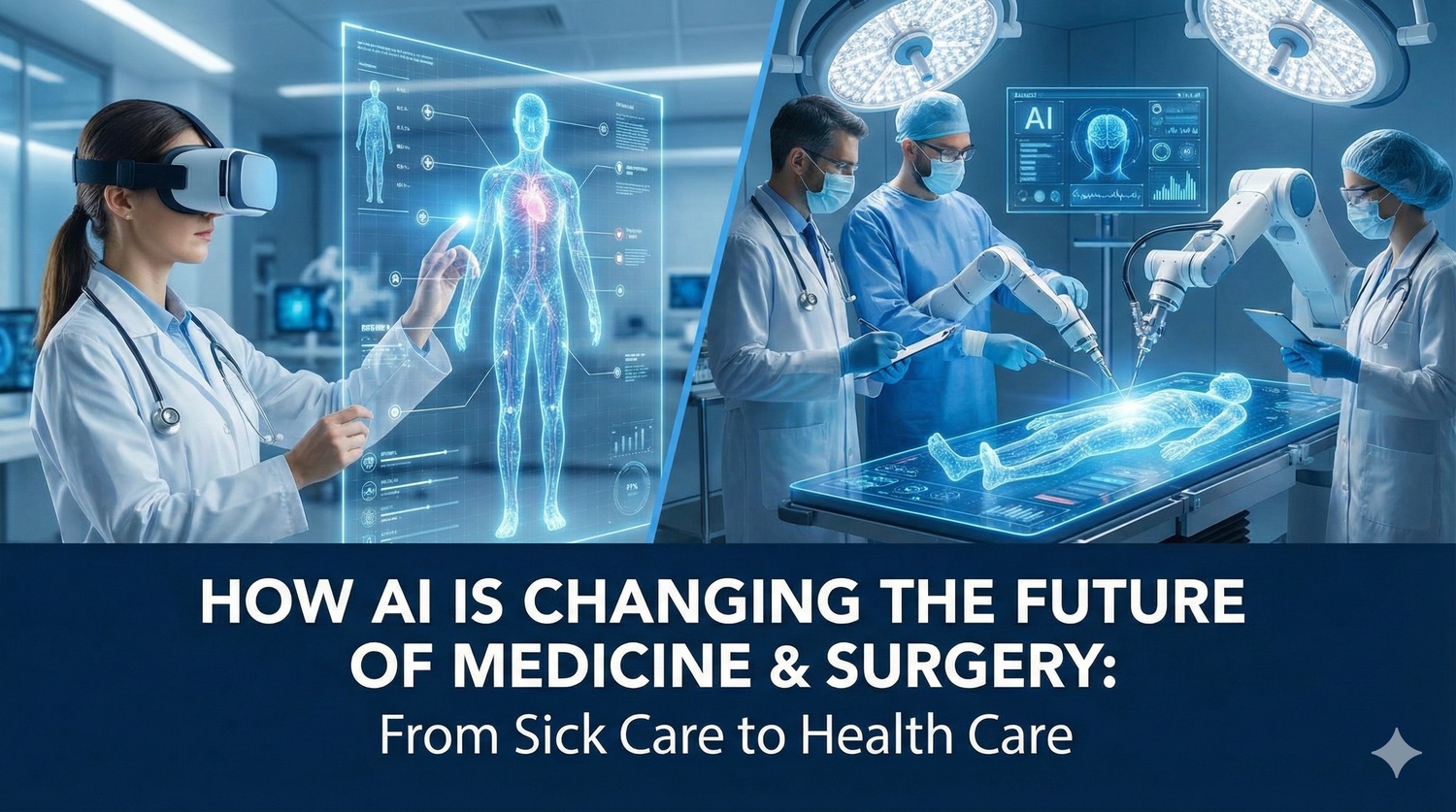
Intro Most people picture a doctor and think of a stethoscope, a white coat, and decades of memorized textbooks. 🩺📖 But the surprising truth? The best doctor of the future won't just be the one with the best memory. It will be the one with the best algorithms. Medicine today is facing a crisis of data. There is too much information for any single human brain to process, leading to misdiagnoses, burnout, and "one-size-fits-all" treatments. 📉 AI is not here to replace the doctor. It is here to give them superpowers. From predicting heart attacks before they happen to guiding robotic hands during delicate surgery, we are moving from the age of "Sick Care" to true "Health Care." Let’s walk through how AI is rewriting the rules of saving lives. 🚀
🔍 Step 1: The Super-Radiologist — Seeing the Invisible Radiologists spend hours staring at hundreds of X-rays and MRIs every day. Fatigue is inevitable, and fatigue leads to missed errors. 😴 The AI Shift:
-
AI models, trained on millions of scans, never get tired.
-
They can spot microscopic anomalies—like early-stage tumors—that human eyes easily miss.
-
The Impact: AI acts as a "second set of eyes," flagging urgent cases so doctors can prioritize them. Earlier detection means higher survival rates. 👁️🗨️
🦾 Step 2: Robotic Surgery — The Steady Hand Forget sci-fi droids performing solo surgery. The future is "Cobots" (Collaborative Robots). The AI Shift:
-
Surgeons use robotic systems to perform ultra-precise, minimally invasive procedures.
-
AI filters out natural hand tremors and prevents the robot from moving outside safe zones during delicate operations (like brain or eye surgery).
-
The Impact: Smaller incisions, less blood loss, and much faster recovery times for patients. 🏥
💊 Step 3: Drug Discovery — Fast-Tracking Cures Developing a new drug usually takes 10+ years and costs billions of dollars. It is a massive, expensive gamble. 🎲 The AI Shift:
-
Instead of testing chemicals in a physical lab, AI simulates billions of molecular interactions in virtual space.
-
It predicts which molecules have the highest chance of fighting a specific virus in weeks, not years.
-
The Impact: Cheaper drugs and rapid responses to future pandemics. 🧪
🧬 Step 4: Personalized Medicine — Treating You, Not the Average Right now, if two people have the same disease, they often get the same treatment. But their bodies are completely different. The AI Shift:
-
AI analyzes your unique genetic makeup, lifestyle data, and medical history.
-
It predicts exactly which medication or dosage your specific body will respond to best.
-
The Impact: The end of trial-and-error medicine. Hyper-personalized care plans that actually work. 🎯
⌚ Step 5: Predictive Care — Stopping Sickness Before It Starts Today's medicine is reactive: you go to the doctor after you feel sick. That's often too late. 🤒 The AI Shift:
-
Wearable devices (smartwatches, rings) collect your health data 24/7.
-
AI analyzes trends in your heart rate or sleep patterns and alerts you: "Your data suggests a high risk of a cardiac event in 48 hours. See a doctor now."
-
The Impact: Moving from treating emergencies to preventing them entirely. 🛡️
📝 Step 6: The Return of Empathy — Burndown of Admin Doctors today spend nearly 50% of their time filling out Electronic Health Records (EHRs) on computers instead of looking at patients. The AI Shift:
-
AI-powered "medical scribes" listen to patient consultations and automatically generate accurate clinical notes in real-time.
-
The Impact: Doctors get their eyes back on the patient, not the screen. Empathy returns to the clinic. ❤️
🔮 The Future: The Doctor-Data Scientist The medical school curriculum of 2030 won't just be anatomy; it will be data science. The future belongs to physicians who can interpret AI insights and combine them with human judgment and compassion. The stethoscope is iconic, but the algorithm is the future.
❤️ Final Words The integration of AI into medicine isn't something to fear; it's something to demand. You just need to:
-
✔ Embrace technology as a partner in health.
-
✔ Understand that data is the new blood test.
-
✔ Prepare for a future where biology and technology are inseparable. AI will not replace physicians. But physicians who use AI will replace those who don't. 💬 “Medicine is a science of uncertainty and an art of probability.” — William Osler. (AI just makes the probability much better.) Your healthier future begins today.
🚀 Brainhap Edge At Brainhap, we sit at the exciting intersection of biology, technology, and data. We help students and professionals:
-
✔ Understand the fundamentals of BioInformatics and Medical AI 🧬
-
✔ Learn how machine learning models are trained on medical imaging data 📊
-
✔ Explore the ethics and governance of AI in healthcare ⚖️
-
✔ Build projects that solve real-world health-tech problems 📂
-
✔ Prepare for careers in the booming Digital Health sector 💼 Whether you are a pre-med student or a coder looking to save lives — Brainhap gives you the tools to thrive in the future of medicine. Your journey starts with curiosity. We guide you through the rest. ✨
Unlock Your Full Potential with BrainHap
Don't let uncertainty hold you back. Discover your strengths and build a future-proof career with our AI-driven assessments.
Start Your Free Assessment